


Most hospitality teams put huge effort into beans, grinders, recipes, and training. But there’s one variable that quietly undermines all of that work: water.
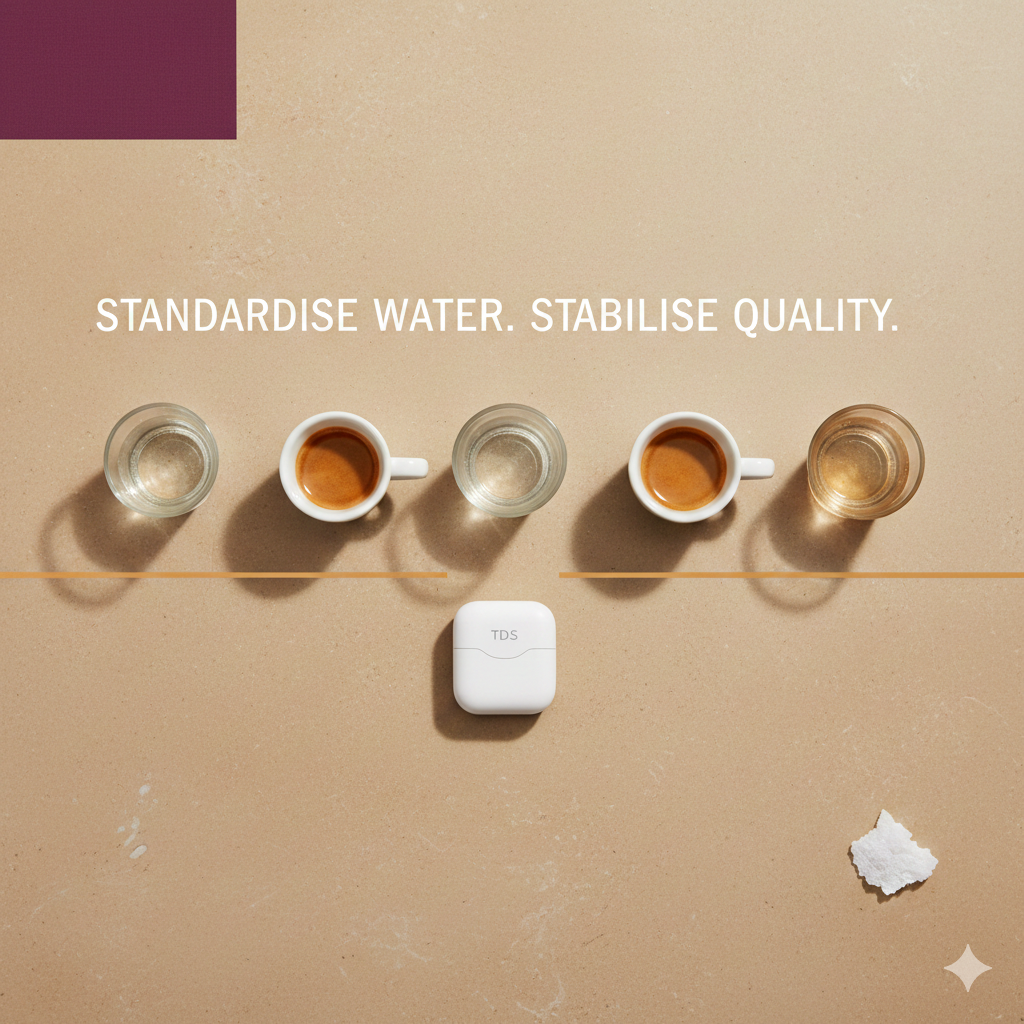
Water makes up 98–99% of the cup. If its mineral balance isn’t controlled, you don’t just get “slightly different” coffee — you get a system that refuses to stabilise, especially across multiple sites.
Why water breaks consistency (even with the same beans + recipe)
You can standardise beans.
You can standardise dose, yield, and time.
You can standardise training.
But if hardness and alkalinity vary from site to site (or even week to week), the coffee will drift anyway.
That drift shows up as:
- Flat extraction (coffee tastes muted, “thin”, lacking sweetness)
- Bitter or hollow flavour (imbalance, harsh finish, sour/bitter swings)
- Inconsistent results across sites (same recipe, different outcome)
- Scale build-up in boilers, heat exchangers, group heads
- Machine failures and expensive call-outs
Coffee quality suffers — and so does equipment uptime.
The trap: “filtered water” is not the same as “controlled water”
Many operators assume the fix is simple: install a filter.
Basic filtration can help with taste (chlorine, odours, sediment), but it does not automatically manage mineral balance for espresso.
That’s why you can end up with:
- Better-tasting water
- …but damaged equipment
- …and drifting coffee quality
Filtration is often one part of the solution — but on its own, it’s not “water control”.
Hardness vs alkalinity (in simple operational terms)
You don’t need a chemistry degree, but you do need clarity on two concepts:
- Hardness: linked to scale risk and the way extraction behaves. Too high and you get scale + unstable extraction; too low and results can become sharp or inconsistent depending on setup.
- Alkalinity: how much the water buffers acidity. If it’s out of balance, coffee can taste hollow, chalky, or oddly bitter even when the recipe looks correct.
Different regions, buildings, and water supplies can vary widely — which is why “it tastes fine here” doesn’t mean it will hold across an estate.
Why multi-site teams feel this pain more
Single-site cafés can “tune around” water without realising it:
- the baristas adjust
- the coffee rotates
- the maintenance team descaling becomes “normal”
In multi-site hospitality, that approach collapses:
- training becomes harder
- quality audits become messy
- the same coffee never tastes the same twice
- equipment costs scale up across the estate
Uncontrolled water becomes a hidden operational risk.
What good looks like: standardise water as part of the coffee system
If you want stability, water must be treated like any other controllable input.
A practical standardisation approach includes:
- A clear target water spec (the “standard” every site aims for)
- Routine testing (quick checks that show drift early)
- A matched treatment setup for each site (because water starting points differ)
- A maintenance rhythm that prevents scale and protects equipment
- Documentation so teams don’t rely on “tribal knowledge”
Next steps checklist (for hospitality operators)
Use this as an internal starting point:
- Stop assuming filtration = control
- Identify the water variables you need to manage (hardness + alkalinity)
- Create a target standard for your coffee program
- Test each site and document baseline readings
- Match treatment to the site (one size rarely fits all)
- Build water checks into QA alongside recipe and calibration
- Track maintenance + scale indicators so problems show up early
When water is standardised, everything else becomes easier to standardise too: extraction, training, maintenance, and customer experience.
Alnur Merali
Nairobi Coffee and Tea Company
FAQ
Is water really that important if we use premium beans?
Yes — water is most of the cup and can override the value of the beans if it’s unmanaged.
We already have filtered water. Why do we still get scale?
Because filtration can improve taste without necessarily managing the minerals that drive scale and instability.
What’s the biggest multi-site mistake?
Standardising beans and recipes, but leaving water uncontrolled — the system won’t stabilise.